Continuous source prior
Noise around category text embeddings expands isolated CLIP anchors into a continuous Gaussian mixture.
SIGGRAPH Asia 2026
Zero-Shot Vector Sketch Generation via GMM Prior Flow in CLIP Latent Space
Shenzhen University
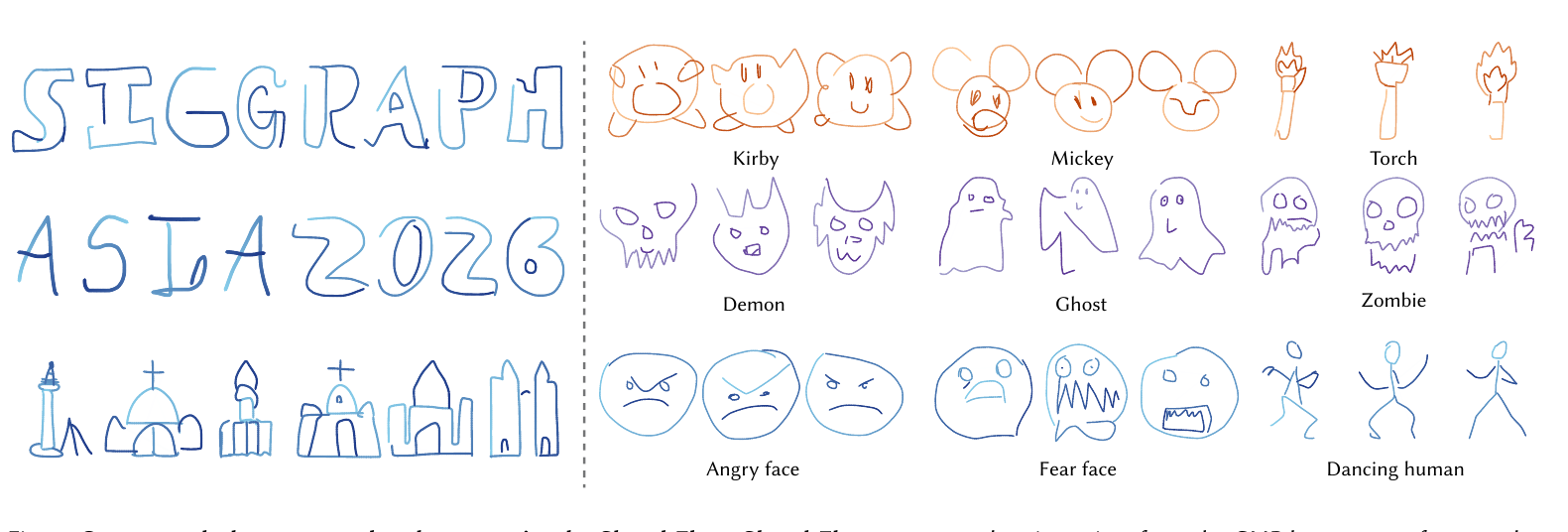
The problem
QuickDraw offers millions of human stroke trajectories but only 345 discrete labels. SketchFlow turns those sparse text anchors into a continuous GMM prior, transports it onto the rendered-sketch CLIP manifold with OT-CFM, and decodes the transported feature into a vector stroke sequence.
Method
The learned vector field bridges the CLIP text-sketch modality gap before the diffusion decoder generates geometry.
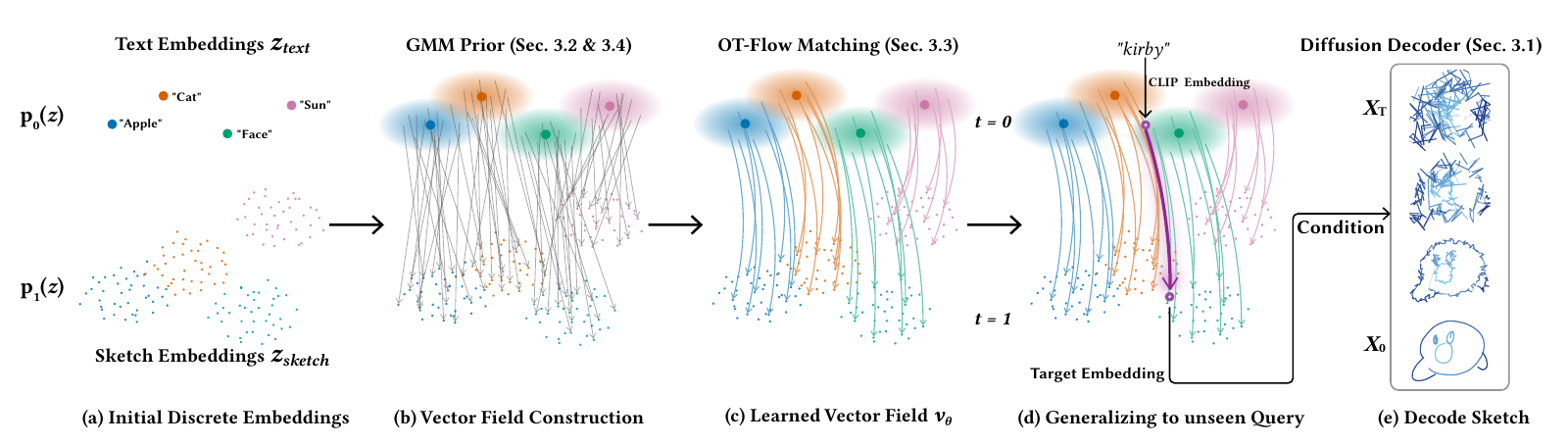
Noise around category text embeddings expands isolated CLIP anchors into a continuous Gaussian mixture.
Category-consistent OT-CFM learns straight trajectories toward the rendered-sketch embedding distribution.
A hybrid 1D U-Net and Transformer diffusion decoder produces 256-point stroke trajectories with pen states.
Results
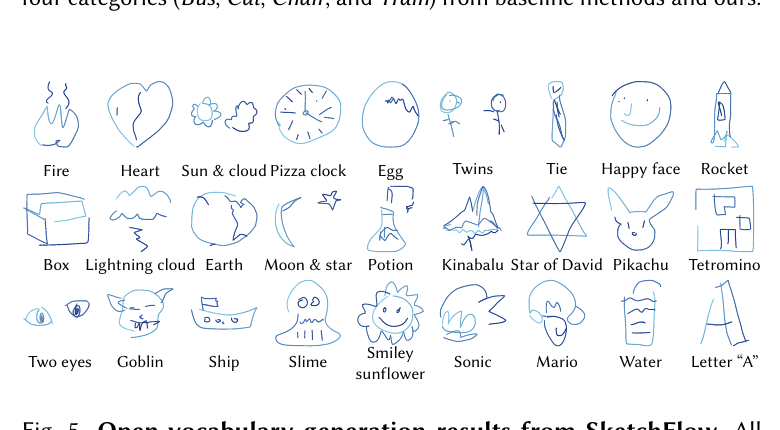
Distinctive visual concepts can follow the learned transport and retain the sparse, human-like style of QuickDraw trajectories.
Drawing process
Each animation follows the generated vector trajectory from its first point to the completed sketch.






















Scope
SketchFlow is trained from the 345 discrete QuickDraw categories. It is not a general image model and does not reliably parse long, compositional prompts.
Its strongest zero-shot behavior appears on visually distinctive concepts that CLIP represents clearly, such as Kirby, Mickey, ghosts, rockets, emotions, symbols, and landmarks.
Citation
Camera-ready paper and final bibliographic metadata will be added after publication processing.
@inproceedings{zhou2026sketchflow,
  title     = {SketchFlow: Zero-Shot Vector Sketch Generation
               via GMM Prior Flow in CLIP Latent Space},
  author    = {Zhou, Jin and Yang, Hongliang and
               Xu, Pengfei and Huang, Hui},
  booktitle = {ACM SIGGRAPH Asia 2026 Conference Papers},
  year      = {2026}
}